Audit Log Filter overview
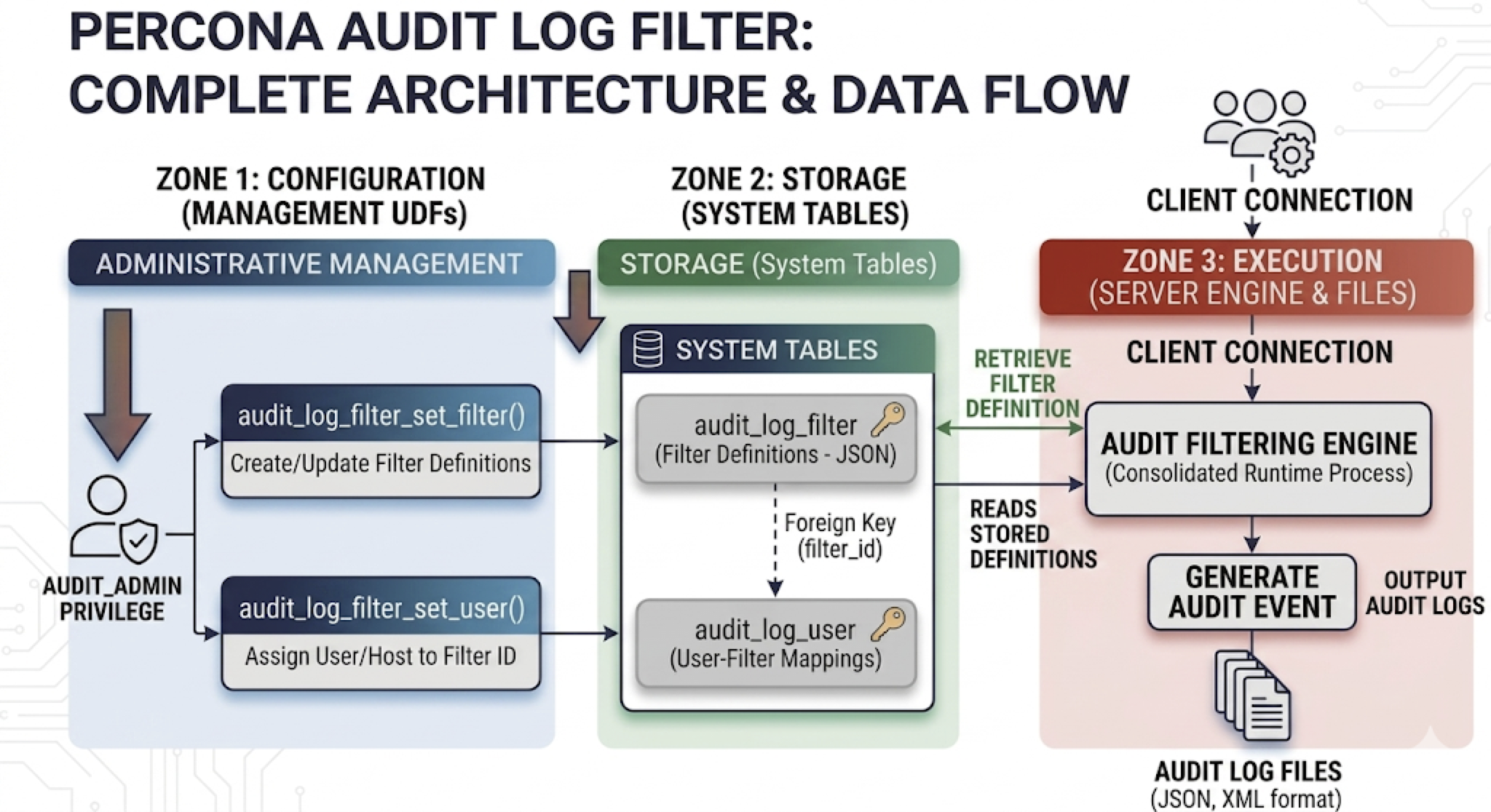
The Audit Log Filter component records, audits, and can block matching connections or statements on the configured server.
With the component enabled, the server writes an audit log file. The file captures connection events, executed statements, and the schemas that sessions touched.
Architecture
The following diagram shows how the Audit Log Filter component sits between the server core, the filter rules, and the audit output.
Why the filter component
The component replaces the legacy audit log plugin. The design meets three goals that the plugin could not:
-
Change rules without restarting the server.
Filter definitions and account assignments live in
mysqlsystem tables. Updates throughaudit_log_filter_set_filter()andaudit_log_filter_set_user()take effect on new sessions and reloads. The server stays online. The legacy plugin requiredaudit_log_*system-variable changes. Those changes often required a restart or plugin reinstall to adjust scope. -
Scope audits per account, not globally.
Each row in
mysql.audit_log_userbinds a user or user pattern to a named filter. The rows let you auditadmin@%andapp@%differently on the same instance. The legacy plugin offered only global include and exclude lists (audit_log_include_accountsandaudit_log_exclude_accounts) on top of a single policy preset. -
Express rules as data, not as knob settings.
Filter definitions are JSON documents. A rule can match an event, a class, a subclass, or a specific field value. You combine matches with
and,or, andnot. Rules can call predefined variables and functions, block execution withabort, and redact statement text in place withprintandreplace. The legacy plugin had policy presets (LOGINS,QUERIES,ALL) with coarser control and no blocking or redaction.
The design delivers a secondary benefit. Events that a filter drops never reach the formatter or the writer. The server therefore avoids the cost of auditing every event and discarding most of the data at the sink. Combined with per-account scoping, operators can raise audit detail on sensitive accounts without paying for verbose logging elsewhere.
See Write audit_log_filter definitions for the JSON grammar, Block statements with an audit log filter for abort, and Redact audit log fields for print and replace.
Audit data flow
The following diagram traces audit events from the server through filtering and formatting into the log (file, syslog, or another handler).
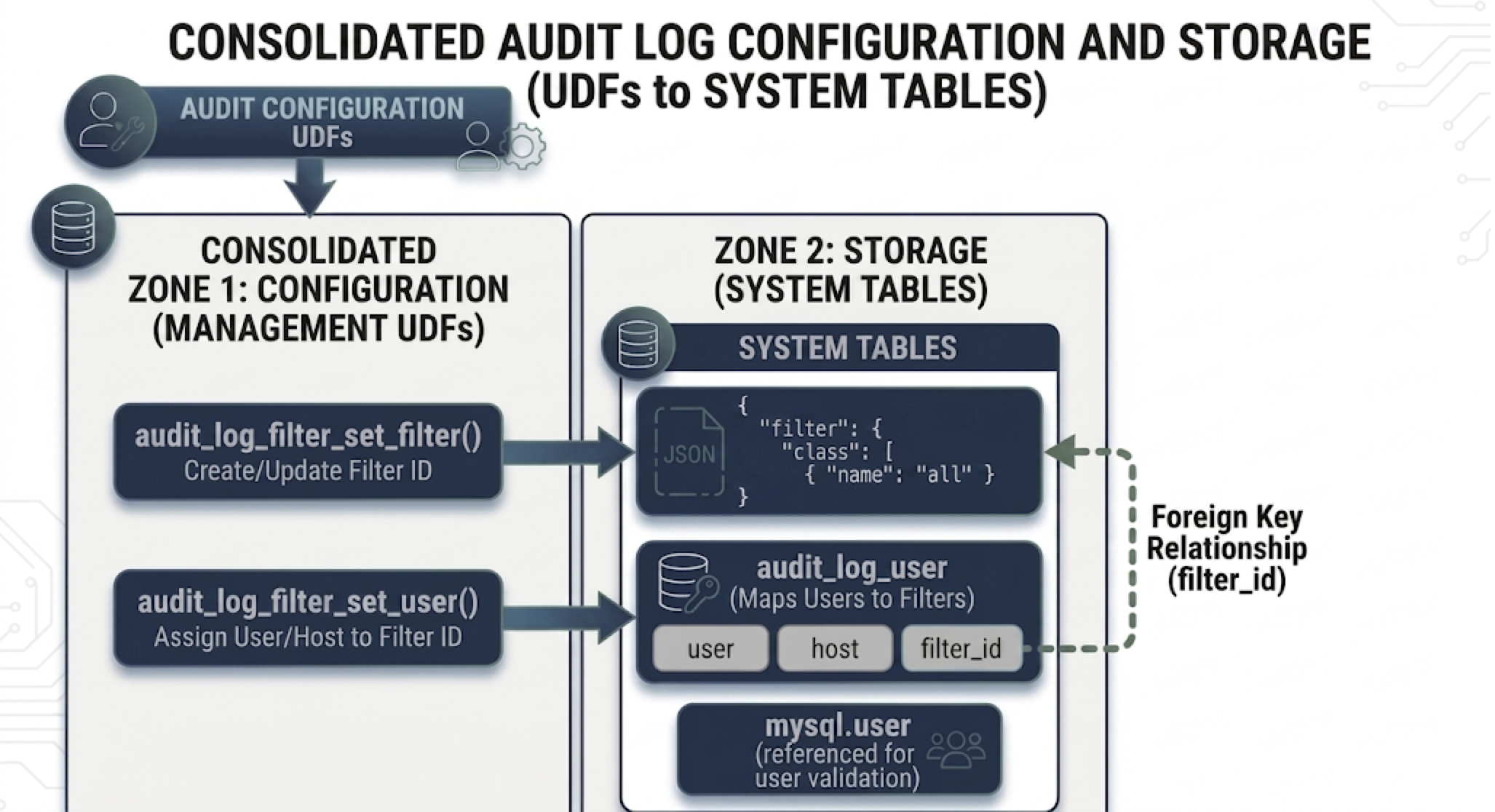
Set audit_log_filter.format at startup. Audit Log Filter file format overview compares JSONL (default), JSON, and NEW.
audit_log_filter.event_mode selects the event classes the component audits. The default is REDUCED. FULL enables every class the component supports, including classes beyond the four core classes. The variable reference lists the full class sets, validation rules, and behavior on older releases.
The component stores filter definitions and account assignments in the mysql system database. Set audit_log_filter.database at startup to use a different database.
You need AUDIT_ADMIN to administer the Audit Log Filter component.
Privileges
The server defines the Audit Log Filter privileges at startup. When the component is not loaded, the server does not expose those privileges.
AUDIT_ADMIN
Grantees of AUDIT_ADMIN can configure the component.
AUDIT_ABORT_EXEMPT
A filter may include an abort rule that blocks matching statements. To bypass those aborts, an account needs both SYSTEM_USER and the global AUDIT_ABORT_EXEMPT privilege granted on *.*.
Only that pair lets matching statements run when a filter would otherwise abort the statement. The component still writes those statements to the audit log.
Audit log filter tables
The Audit Log Filter component uses mysql system tables on InnoDB. The tables hold account assignments and filter JSON. Point the component at another database through audit_log_filter.database when the server starts.
The audit_log_filter table stores named filter definitions:
| Column name | Description |
|---|---|
| NAME | Filter name |
| FILTER | JSON filter definition linked to the name |
The audit_log_user table maps accounts to filters:
| Column name | Description |
|---|---|
| USER | MySQL account user part |
| HOST | MySQL account host part |
| FILTERNAME | Name of the assigned filter |
Filter storage hierarchy
The following diagram shows how rows in audit_log_filter map to audit_log_user, including the default % account.
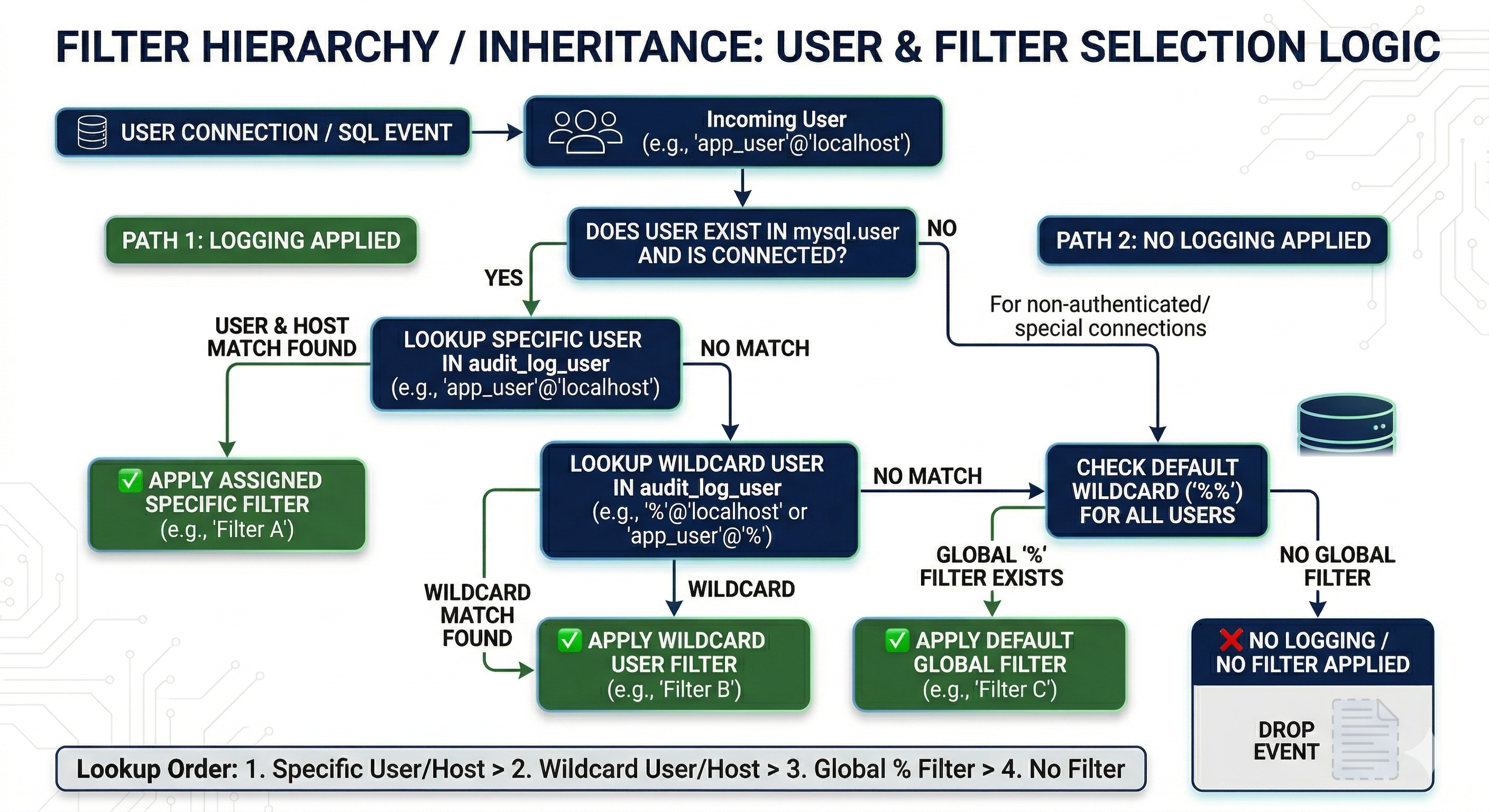
On connect, the component loads one filter definition from the matching USER/HOST row in mysql.audit_log_user. If no row matches, the component falls back to the default account (%). A concrete account such as admin@localhost overrides a % assignment.
Rules inside the filter’s JSON apply after load. For example, log conditions that test user.str or host.str with field items narrow which events get written. The rules do not act as a second assigned filter. See Filter the Audit Log Filter logs for assignment order and wildcards. See Write audit_log_filter definitions for the JSON grammar that log conditions use.
Additional reading
-
Migrate to the audit log filter component — variable mapping, policy translation, worked example, and cutover for either audit plugin
-
Upgrade components — general plugin-to-component transition procedure
-
Audit log plugin — deprecated plugin reference